The Back-to-School Supply List That Accidentally Became My Hobby Roadmap
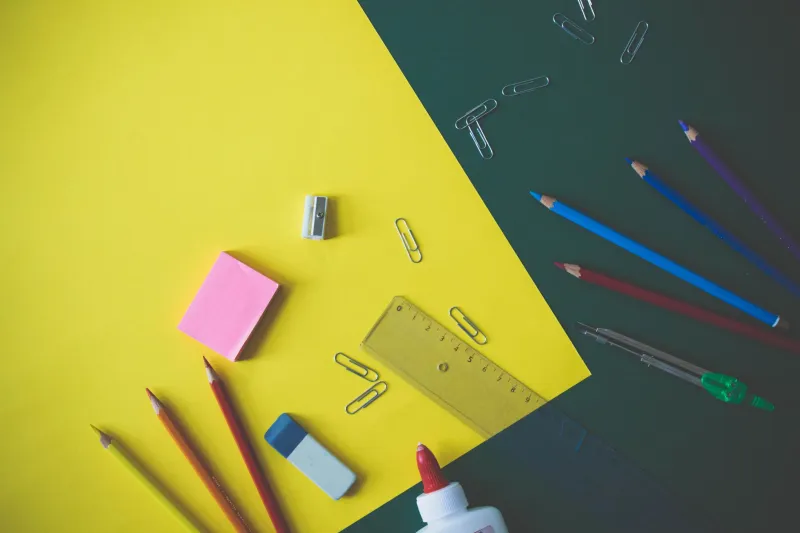
Every August, I do the same thing. I pull up the school supply list on my phone, wander through Walmart in a half-daze, toss things into the cart that I don't fully understand the purpose of, and somehow spend $60 on items that will live in a backpack until June. Colored pencils. Graph paper. A three-hole punch. Index cards. Glue sticks — always more glue sticks than any child could ever humanly need.
This year, though, something shifted.
I was standing in the stationery aisle, staring at a 24-pack of Crayola colored pencils, when it hit me: I have no hobbies right now. Like, zero. I'd wrapped up a month of random weekend experiments back in the spring and hadn't replaced them with anything. My creative life had gone completely quiet. And here I was, surrounded by supplies that were technically mine to use too — I'd paid for them, after all.
So I made a decision that was either genius or deeply unhinged: I was going to use my kids' school supply list as my personal hobby assignment sheet for the next month. Every item on that list had to point me toward something I'd try. No buying new stuff. No elaborate planning. Just whatever was already in the cart.
Reader, the glue sticks changed my life.
Glue Sticks → Bookbinding (Yes, Really)
I'll be honest — when I wrote "glue sticks" on my little self-assigned hobby list, I had no idea where that was going. I Googled "crafts that use glue sticks" expecting to find sad Pinterest projects involving googly eyes. Instead, I tumbled headfirst into the world of bookbinding.
Turns out, basic bookbinding — specifically a style called pamphlet stitch — uses very little equipment. Some folded paper, a needle, waxed thread, a bone folder if you're fancy (I used a butter knife), and yes, a glue stick for attaching end pages. I watched exactly one YouTube video, folded up some leftover printer paper, and made a tiny notebook that looked surprisingly not terrible.
By week two, I had made seven of them. My kids started requesting custom ones. I gave one to my neighbor. I am not saying I'm a bookbinder now, but I am saying I haven't bought a journal since August, so.
Graph Paper → Urban Sketching (An Unlikely Gateway)
The graph paper was trickier to decode. My first instinct was "math" and I immediately wanted to move on. But then I remembered seeing urban sketching pop up on my Instagram feed — those loose, perspective-heavy drawings people do in coffee shops and on street corners, capturing buildings and street scenes with wobbly, imperfect lines.
Graph paper, it turns out, is a fantastic tool for learning basic perspective. The grid keeps you honest when you're trying to figure out where a horizon line belongs or why your building looks like it's melting. I started small — our front porch, the view from my kitchen window, the Target parking lot (an iconic American landscape, truly).
I'm not great at it. My trees look like broccoli and my cars look like potatoes. But there is something almost meditative about sitting outside with a pencil and a piece of graph paper, trying to figure out how to make a flat surface look three-dimensional. It scratches a brain itch I didn't know I had.
Colored Pencils → Something I Was Not Expecting
Okay, so the colored pencils. I assumed this one would be the easy, obvious one. Coloring books for adults are everywhere. I'd done that phase back in 2016 like everyone else. I figured I'd buy a cheap mandala book and call it done.
But then my youngest sat down next to me one afternoon and said, very seriously, "Mom, you're not blending right." She is eight. She proceeded to show me — with genuine authority — how to layer colored pencil strokes to create depth and shadow. She learned it from a YouTube channel aimed at kids.
I spent the next week learning colored pencil techniques from children's art tutorial channels, which is a sentence I never expected to type. Burnishing. Layering. Using a white pencil to blend. It's genuinely a skill, and I had completely underestimated it. The 24-pack of Crayolas I bought for my kid became the most-used art supply in my house.
Index Cards → Hand-Lettering (The Obsession I Didn't Ask For)
This one is entirely the index cards' fault and I want that on record.
I had a stack of them left over after the school shopping trip and I thought, vaguely, that I'd use them to organize recipes or something responsible. Instead, I started doodling letters on them. Then I looked up brush lettering. Then I ordered a $6 pack of brush pens from Amazon (the only new purchase I allowed myself this entire month). Then I watched four hours of calligraphy videos in one sitting.
Hand-lettering on index cards is perfect, actually — the small size means you finish something in ten minutes, which is exactly the kind of creative win a busy mom needs. I've been making little quote cards and leaving them in random places around the house. My husband found one that said "you're doing great, sweetie" tucked inside his coffee mug. He thought it was from the kids. I let him believe that.
What I Actually Learned From All of This
Here's the thing about using your kids' school supplies as a hobby jumping-off point: it works because there are no stakes. You're not investing in a new kit. You're not committing to a class. You're just picking up something that's already sitting on the counter and asking, "what could this be?"
The supplies that seemed the most boring — graph paper, index cards — turned out to be the most generative. The ones I thought I understood — colored pencils — surprised me completely. And the glue sticks gave me a whole new skill I'm genuinely proud of.
If you've got a school supply list sitting around right now, I'd genuinely encourage you to look at it differently. Not as a chore list, but as a creative prompt. What does a ruler make you think of? What could you do with a composition notebook beyond homework? Where does a pack of highlighters take your brain?
Dabbling doesn't require a budget. Sometimes it just requires looking at the ordinary stuff you already have and being willing to ask a slightly weirder question about it.
Also, maybe buy extra glue sticks. Just in case.